

Key Takeaways
We can work comfortably in Medellín by matching the neighborhood and workspace to each day’s demands.
- Choose a workspace based on calls, concentration, schedule, and length of stay.
- Laureles suits walkable routines, while El Poblado offers more coworking variety.
- Check internet, backup power, noise, access hours, and meeting-room policies first.
- Compare total costs, including transport, food, printing, and backup connectivity.
- Work discreetly, protect devices, and treat each neighborhood as a lived community.
What should digital nomads look for in a Medellin workspace?
A digital nomad guide to medellin workspace should start with your actual work routine. For deep work, choose quiet seating and dependable internet. For frequent calls, prioritize booths, meeting rooms, and clear phone policies. We should also confirm backup arrangements before paying for access.
Matching workspace types to your work routine
Our first decision is whether we need mobility, consistency, or privacy. A day pass works for changing plans, while a dedicated desk helps create a stable daily rhythm. Private offices make more sense when several people share confidential work or regular client meetings.
We can also separate workdays by purpose. A café may suit writing or planning, while a coworking floor is better for video calls. If we are staying briefly, flexible access avoids paying for unused membership time.
Comparing coworking spaces, cafés, and private offices
Coworking spaces usually provide a more predictable work environment than cafés. Cafés can be pleasant for a short session, but seating, music, outlets, and customer expectations vary. Private offices offer the strongest control over sound and privacy, though they usually cost more.
A practical comparison should include what is actually included. Some spaces bundle coffee and reception services, while others charge separately for rooms or printing. We should judge the full arrangement rather than the advertised entry price.
Checking internet reliability, noise, and backup options
We should ask whether internet performance is consistent during busy periods, not only what speed is advertised. A quick test can reveal latency, upload limitations, or weak coverage in a particular corner. The best workspace also explains what happens during a service interruption.
Reliable backup planning matters for calls, payments, and deadlines. A Colombian SIM or eSIM can provide a second connection, while a charged power bank helps during short outages. We can also save important files locally before beginning a long work session.
Considering meeting rooms, phone booths, and call policies
Call-heavy work requires more than a desk and Wi-Fi. We should ask how rooms are booked, whether booths have time limits, and whether calls are acceptable at open tables. A clear policy prevents awkward interruptions and protects other members’ concentration.
Workspace details also affect client impressions. A quiet booth, stable camera position, and neutral background are useful for professional meetings. For travel between appointments, an executive car service can illustrate the broader principle: predictable transport creates more usable working time, even when we ultimately choose local options.
Which Medellin neighborhoods are best for remote work?
Laureles is often the easiest starting point for a relaxed remote-work routine. El Poblado offers a wider selection of coworking spaces and social venues. Envigado is quieter, while Provenza and Parque Lleras suit people who value central access and evening activity.
The right choice depends on where we stay, how often we commute, and when we work. Medellín’s hills and traffic can make short distances feel longer. We should test a route during the hours we expect to travel.
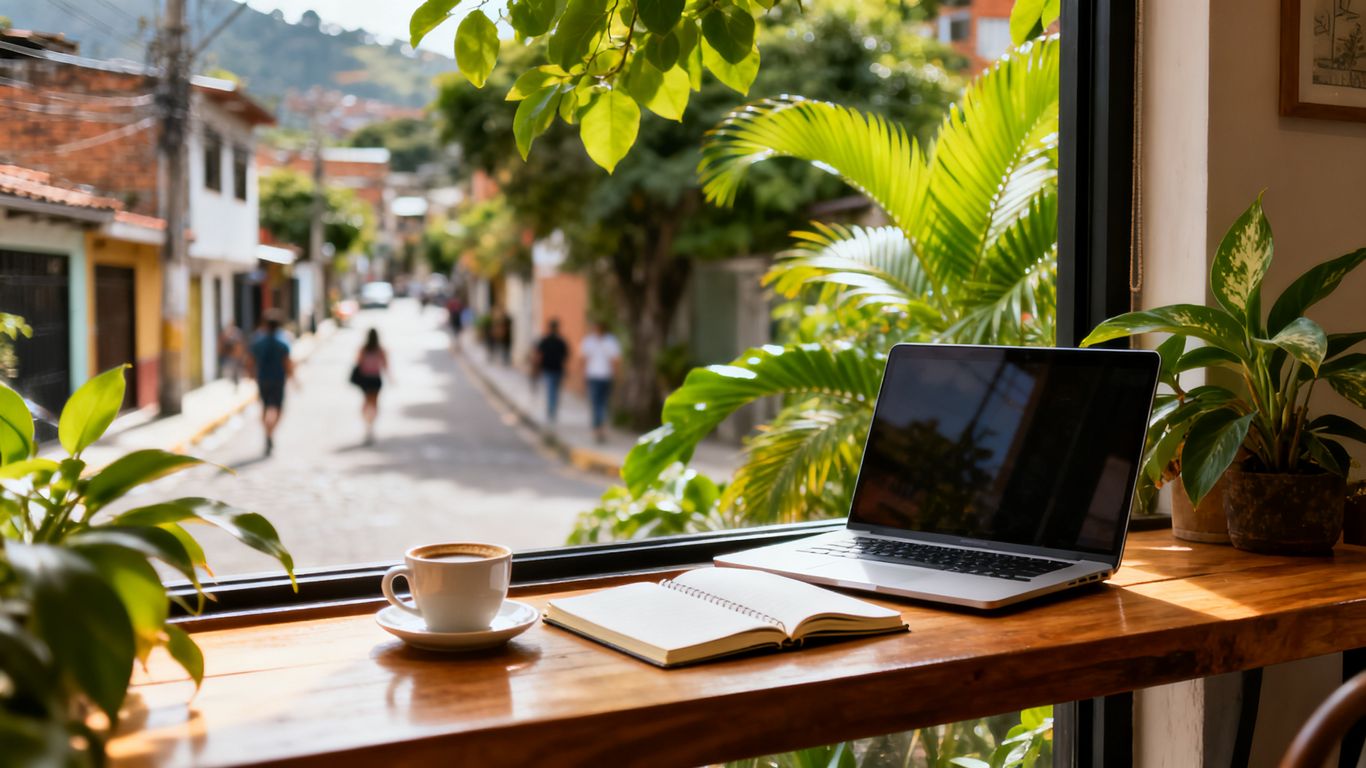
Laureles for walkability and relaxed daily routines
Laureles has broad streets, many cafés, and a residential feel that supports regular walking. It can work well for nomads who want breakfast, errands, exercise, and work within one area. The flatter layout is also convenient when we carry equipment.
The neighborhood has a strong coffee culture, and our specialty coffee guide can help identify cafés that suit a short work session. We should still ask about outlet access and purchase expectations before settling in for several hours.
Laureles also offers a cultural break from desk time. The Colombian Cacao Experience is a hands-on bean-to-bar workshop in Laureles, lasting approximately 3.5 hours and costing 160,000 COP per person. It includes roasting raw cacao over fire, peeling and grinding beans on a traditional molino, a cacao ceremony, an exfoliation ritual, and a cacao sour cocktail.
El Poblado for coworking variety and social access
El Poblado gives us many options within a compact visitor-oriented area. It can suit people who want coworking access, restaurants, cafés, and evening activities nearby. The trade-off is a busier environment and more variation in noise and pedestrian traffic.
We should inspect the immediate street, not only the building. A workspace near a busy nightlife corridor may feel convenient during the day but distracting later. For coffee-focused breaks, a coffee cupping guide can help us plan a local activity without confusing it with a work venue.
Provenza and Parque Lleras for centrality and nightlife
Provenza and Parque Lleras are useful when centrality and evening access matter most. They are less suitable for everyone’s full workday, especially when music, visitors, or late-night activity affects concentration. We can work nearby during daylight and relocate for quieter sessions.
This area rewards a schedule built around timing. Morning work may be calmer, while afternoons and evenings require more attention to sound and pedestrian movement. We should avoid assuming that a popular social district will provide a quiet desk throughout the day.
Envigado for a quieter residential setting
Envigado appeals to nomads who prefer a slower residential base. It offers local services, restaurants, and a less visitor-centered rhythm in many areas. The commute into central Medellín may be less convenient, so location becomes more important.
Before committing, we should calculate the route to the workspace and test it once. A quieter home base does not help if every workday begins with a long, unpredictable transfer. It works best when our workspace and accommodation sit within the same practical orbit.
Comparing commute times, terrain, and local amenities
Neighborhood choice should include walking conditions, hills, rain exposure, and access to food. A ten-minute map estimate can change with traffic, steep streets, or a sudden shower. We should compare the entire routine, not just the distance between two points.
For a quick planning check, we can record these details before booking:
- Door-to-door travel time during our usual working hours.
- Nearby food, pharmacy, café, and ATM options.
- Covered walking routes and places to wait safely.
- Availability of transport after the workspace closes.
This simple check makes neighborhood decisions more practical. It also reduces the temptation to move between districts unnecessarily during a busy workweek.
How do coworking spaces in Medellin differ?
Medellín coworking spaces vary by access model, privacy, community, and operating schedule. Some are designed for flexible visitors, while others prioritize members with fixed desks. We should compare the rules as carefully as the furniture.
A good fit depends on our expected hours and work style. Someone making occasional calls needs different facilities from someone writing quietly every afternoon. Trial access can reveal whether the space feels usable beyond its marketing photographs.
Flexible day passes and short-term access
Day passes are useful during short stays or changing itineraries. They let us test noise, seating, internet performance, and staff support before making a longer commitment. We should confirm whether the pass covers the entire day or only defined hours.
Short-term users should also ask about storage and peak-time availability. A pass may provide entry without guaranteeing a preferred desk. That distinction matters when we need a consistent setup for a deadline.
Dedicated desks and monthly memberships
Dedicated desks provide continuity for longer stays. We can leave a monitor, notebook, or other permitted equipment arranged in one place. Monthly memberships may also include meeting-room credits or community access, but the details vary by provider.
We should read the cancellation terms before paying. Some memberships renew automatically, require notice, or limit access on weekends. A lower monthly rate may not be cheaper if our stay ends unexpectedly.
Private offices for teams and client calls
Private offices are most useful when privacy, shared schedules, or confidential conversations drive the decision. They can reduce interruptions for small teams and create a reliable setting for client calls. We should check ventilation, natural light, sound transfer, and included furniture.
Room size is only one consideration. A small office with dependable connectivity may work better than a larger room with poor acoustics. We should also confirm whether reception, mail handling, and access for guests are included.
Community events and networking opportunities
Community programming can help us meet other professionals, but it should not determine the workspace alone. We should ask how often events occur and whether they are open to day-pass users. Some nomads prefer introductions and workshops, while others need uninterrupted quiet.
Networking works best when it fits our schedule. We can attend one event, learn the local rhythm, and keep the rest of the week focused. A useful workspace does not require constant social participation.
Access rules, opening hours, and holiday schedules
Opening hours affect early calls, late deadlines, and weekend work. We should confirm entry procedures, identification requirements, guest rules, and holiday closures. A space that closes before our main work period may be unsuitable despite good facilities.
Local schedules can change around public holidays or special events. We should save the workspace contact details and ask about temporary changes. This is especially helpful when a monthly membership includes access outside staffed hours.
How much does a Medellin workspace cost?
Workspace costs in Medellín depend on access length, privacy, and included services. Day passes are flexible, while monthly plans usually reduce the daily average. We should compare the total weekly expense rather than choosing from a headline price.
Prices change by provider and season, so we should request current rates directly. The same space may offer different terms for hot desks, dedicated desks, and offices. Transport and meals also belong in the work budget.
Typical day-pass and weekly pricing
Day passes are convenient for testing a space or covering an occasional meeting day. Weekly access may offer better value when we expect to work consistently but cannot commit monthly. We should ask whether the pass includes coffee, printing, rooms, and extended hours.
A useful comparison records both price and usable hours. A cheaper pass with limited access may cost more per productive hour. We should also allow for days when neighborhood cafés or accommodation provide a better fit.
Monthly memberships and contract requirements
Monthly memberships can make sense for stays of several weeks or longer. Before signing, we should confirm the billing date, renewal process, cancellation notice, and access restrictions. Some spaces may require a deposit or identification for longer arrangements.
A membership is valuable when we will use it regularly. If travel plans are uncertain, flexible access may reduce financial risk. We should calculate the break-even point based on expected working days.
Extra charges for meeting rooms and printing
Meeting rooms, printing, lockers, and guest access may be separate charges. These extras can change the final cost for consultants, recruiters, and small teams. We should ask for rates before booking a space for client work.
The same applies to equipment. Monitors, adapters, and soundproof rooms may not be included in a basic plan. A short written price list helps us avoid surprises at checkout.
Comparing workspace costs with café spending
Cafés can appear inexpensive because there is no formal access fee. Regular purchases, meals, transport between venues, and limited outlets can make the daily total less predictable. We should compare the cost of a café routine with the productivity it provides.
A café also carries social expectations. Buying one drink may not justify occupying a table for an entire afternoon. We should rotate locations respectfully or use a coworking pass when we need a fixed base.
Budgeting for transport, food, and backup internet
Our work budget should include the costs surrounding the desk. A reliable workspace may be farther away, while a nearby option may require mobile data or more frequent purchases. We should price the complete routine before deciding.
These questions keep the calculation grounded:
- How many days will we work outside our accommodation?
- How much will daily transport cost at our usual hours?
- Will we buy lunch, coffee, or snacks near the workspace?
- Do we need a SIM, eSIM, power bank, or backup battery?
After adding these items, the difference between workspace options becomes clearer. We can then pay for reliability where it genuinely protects our work.
What practical setup do digital nomads need in Medellin?
A practical setup combines connectivity, transport, payments, and weather planning. We should prepare a primary connection and a backup before the first deadline. Small tools can prevent a minor disruption from becoming a lost workday.
Medellín’s conditions change across neighborhoods and hours. Rain can affect walking, traffic, and mobile signal indoors. We should keep plans flexible without relying on improvisation for essential work.
Understanding internet speeds and power reliability
We should test download, upload, latency, and video-call performance at the actual desk. Ask whether the network has separate guest and member access, and whether staff monitor interruptions. Power outlets should be close enough to avoid stretching cables across walkways.
A small backup kit helps. We can carry a charged power bank, universal adapter, and local cable. Important files should remain available offline when the connection is uncertain.
Choosing a Colombian SIM card or eSIM
A Colombian SIM card or eSIM provides a useful second connection. We should compare coverage, data limits, activation requirements, and hotspot permissions. Keeping the home number active may matter for banking or account verification.
We should install and test the backup before needing it. A phone with insufficient battery or a plan that blocks tethering will not solve an outage. We can also store support contacts and account details securely.
Finding reliable transport to and from workspaces
We should plan transport around daylight, rain, traffic, and closing hours. Maps help estimate routes, but a trial journey gives better information about hills, crossings, and waiting time. We should use established services and avoid displaying expensive equipment while waiting.
Transport choices should support the workday rather than create extra stress. If a route feels uncomfortable after dark, we can adjust the schedule or choose a closer venue. The same practical approach used in a digital agency comparison applies here: weigh continuity, accountability, and fit instead of choosing by price alone.
Using maps, payment apps, and translation tools
Offline maps, a payment app, and a translation tool make routine tasks easier. We should save the workspace address in Spanish and keep a screenshot available without data. Cash remains useful when a small café or taxi cannot process our preferred payment.
We should protect account access with device locks and two-factor authentication. Public Wi-Fi should not be treated as private. A short Cookie Policy can remind us that digital privacy depends on how websites and services handle personal data.
Preparing for rain, heat, and changing work conditions
Rain can arrive quickly and alter a short walk into a difficult commute. We should carry a light waterproof layer, protect electronics, and choose bags with secure closures. Indoor temperature may also vary, so a thin extra layer is practical.
Weather planning should remain simple. We can schedule outdoor errands between calls and keep a nearby backup venue in mind. Even unrelated practical planning, such as seamless gutter installation, reinforces a useful principle: local conditions should shape preparation before problems appear.
How can digital nomads work safely and respectfully in Medellin?
We can work safely in Medellín by reducing exposure, choosing sensible routes, and following local workspace rules. No neighborhood should be treated as risk-free, and no precaution replaces awareness. Discretion is especially important when using expensive laptops and phones in public.
Respect also improves the working experience. We should learn basic Spanish courtesies, follow café purchasing norms, and avoid treating residential neighborhoods as temporary backdrops. A careful routine leaves more room for exploration.
Protecting laptops and phones in public spaces
We should keep devices away from street-facing tables and avoid leaving phones beside an open window. Bags belong under a leg, between our feet, or in another position we can monitor. Backups and device tracking should be enabled before travel.
At cafés, we can choose seats with a wall behind us and limit visible screens. We should avoid discussing account details aloud. These small habits reduce opportunity without making the workday unnecessarily tense.
Choosing secure routes and appropriate working hours
We should plan routes before leaving and use well-trafficked streets appropriate to the time. Late calls may require a workspace near accommodation or transport. We should not assume a familiar daytime route feels identical after dark.
A simple schedule can reduce exposure. Finish packing before leaving, keep the phone away while walking, and use transport when the route or weather warrants it. Local advice from trusted staff can help us adjust plans.
Following coworking etiquette and local customs
Coworking etiquette is straightforward: keep calls at an appropriate volume, respect reserved desks, and leave shared areas clean. We should ask before photographing people or private work. Greetings and patience matter, especially when communication takes longer in a second language.
We can also respect café customs. Order regularly, avoid occupying peak tables without a purchase, and move when staff need the space. A calmer work environment usually follows when we treat workers and neighbors as partners rather than service features.
Managing calls, photography, and personal data
Calls should happen in booths or rooms when confidentiality matters. We should use headphones, mute notifications, and avoid showing documents in public frames. Photography requires extra care because other members may appear in the background.
Personal data deserves the same attention as physical belongings. We should lock screens before stepping away and avoid saving passwords on shared devices. If a call concerns sensitive information, a private office or accommodation may be safer.
Balancing focused work with neighborhood exploration
A productive stay does not require working every hour in a coworking space. We can block focused periods, take local breaks, and explore after deadlines. Neighborhood walks, food, and cultural activities become more enjoyable when they are not squeezed between urgent calls.
Laureles offers one practical cultural option after a workday or during a weather change. The Colombian Cacao Experience provides a hands-on bean-to-bar workshop in the neighborhood, with an approximately 3.5-hour session and listed price of 160,000 COP per person. We should book around work commitments because the activity is a scheduled workshop, not a drop-in desk alternative.
For wider planning, our Medellín activities guide can help place cultural stops around work blocks. We should leave buffer time for transport and avoid overloading the same day. A balanced schedule protects both concentration and curiosity.
Conclusion
The right Medellín workspace depends less on a universal ranking than on our routine, neighborhood, budget, and need for privacy. We can begin with a flexible pass, test the commute and connection, then commit only when the arrangement works in practice. With sensible device habits and respectful local behavior, Medellín offers a workable base for focused remote days and thoughtful time beyond the desk.
Frequently Asked Questions
Which Medellín neighborhood is easiest for digital nomads?
Laureles is a practical starting point because many daily needs can be reached on foot. El Poblado offers more coworking and nightlife variety, while Envigado suits quieter routines.
Are cafés suitable for a full remote-work day in Medellín?
Some cafés work well for short sessions, writing, or planning. For long calls and dependable seating, a coworking space usually offers clearer expectations and better facilities.
Should we book a coworking membership before arriving?
Usually, we should test access, noise, internet, and commute conditions first. A day pass or short-term option reduces the risk of paying for a poor fit.
What should we check before choosing a Medellín workspace?
Check internet performance, power access, opening hours, call rules, room fees, and backup options. Also confirm whether the advertised price includes the services we actually need.
Is a SIM card useful for remote work in Medellín?
Yes, a Colombian SIM or eSIM can provide backup data and hotspot access. We should verify coverage, data limits, activation requirements, and tethering before relying on it.
How can we protect our laptop while working in public?
Choose a seat with limited street visibility, keep belongings physically secured, and lock the screen whenever we step away. Avoid displaying sensitive information or leaving devices unattended.
How can we balance work and exploring Medellín?
We can schedule focused blocks, add transport buffers, and reserve cultural activities around deadlines. Keeping exploration close to the workspace often makes the routine easier and less rushed.
Written by the editorial team at Things To Do Medellin, featuring local insights and verified recommendations from the city’s top-rated cultural artisans.